I’m writing this on a Sunday night, just before work properly starts again for a lot of people in 2026.
Some companies will ease back in tomorrow. Others won’t really wake up until next week. Either way, inboxes are about to refill, calendars are about to harden, and the relaxing memories of the Christmas break will fade quickly into the background.
This week will be different for me. It’s the first time in about twenty-one years that I haven’t had a job to go back to. Sure, I’ve changed roles plenty of times, but I’ve almost always finished one job on a Friday and started the next on a Monday. Even the longer gaps were measured in days, not weeks. Holidays existed, of course, but they always had edges, a return date, a sense of things waiting patiently for me to come back and pick them up again.
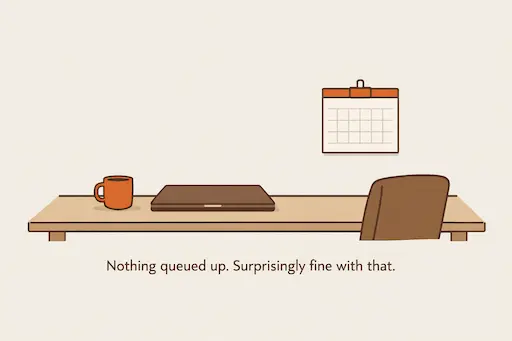
No return date.
This gap doesn’t have that shape and I expected that to feel uncomfortable. Maybe even stressful. Instead, what surprised me most was how calm it felt. Not euphoric or celebratory. Just quiet in a way I’m not used to. That unfamiliar calm has been the most noticeable thing about this break so far.
I’ve had time off before. Just never like this. There have been holidays, usually a week or two around Christmas, sometimes a few extra days stitched onto Easter. They helped, but they never really created distance. Even when I wasn’t working, I was still attached. There were problems waiting for me. Decisions paused mid-air. People doing more than their share while I was away. I’d be technically on leave, but mentally still half plugged in.
Between jobs hasn’t been much different. For most of my career, one role ended on a Friday and the next started on a Monday. Once, I managed a slightly longer gap — two whole days off — and that was notable enough to remember. I’ve always liked the idea of taking a proper month between roles, but every time I tried, another offer arrived before I could really stop.
There were a couple of points years ago where I did stop properly, but only because I had to. Short mental health breaks, about a week at a time. Necessary, restorative, and very contained. I don’t mind acknowledging that now. It’s part of the story, but it’s not the story.
The point is: I’ve been moving more or less continuously for a long time.
That’s why this feels different. There’s nothing queued up behind me. No role to return to. No inbox filling quietly in the background. No sense that I’m borrowing calm from a future version of myself who will have to pay it back later.
That absence is what’s been strangely freeing. I’ve noticed it most in the small things. I don’t catch myself rehearsing conversations I’ll have next week. I don’t feel the low-level guilt that usually sits underneath time off — the sense that I’m enjoying myself but the work wont magically disappear while I’m not there. When I think about work, it’s not about firefighting or deadlines. It’s about ideas. Possibilities. Things I’ve wanted to explore but never quite had the space to.
That shift matters more than I expected. A few days into this break, I came across a podcast where Leila Hormozi made a point that stuck with me. She said that a lot of people who think they want to quit don’t actually want to quit at all. What they need is rest. Real rest. Not a long weekend or a forced holiday to use up annual leave but where you keep one eye on Slack. Sometimes a week is enough. Sometimes it’s longer.
What landed for me wasn’t the advice itself so much as the permission in it. For people who are wired to keep moving, founders, senior engineers, anyone who’s spent years being the person who figures things out, stopping can feel irresponsible or like weakness. Like you’re letting momentum leak away. Hearing someone frame rest not as retreat, but as recalibration, shifted something for me. It didn’t make me want to disengage. If anything, it did the opposite. Instead of scanning for the next shiny thing or panicking about what comes next, I found myself leaning back into the things I care about. Writing. Thinking. Spending time in the garden with my hands in actual soil instead of another abstraction. Spending proper, unhurried time on The Cynical Dev and not squeezing it into the cracks between meetings. Giving it the attention it’s probably deserved for a while.
I told myself I’d properly switch off until Monday. I didn’t quite manage that. A mere 15 days on holiday and my brain had already started wandering back into familiar territory. Sketching ideas. Planning how I might structure my days. Thinking about what I want this year to look like, and how I want to balance job searching, writing, and everything else without letting any one thing consume the rest.
What was different was the tone of those thoughts. None of it felt urgent. Nothing was being demanded of me. It was motion without pressure, which is a new experience in itself. Looking back, I think that constant forward motion has shaped how I work more than I realised. I tend to get deeply invested in the teams and systems I’m part of, which is rewarding, but it also makes it hard to ever fully let go. There’s always something ticking over in the background. Some thread worth pulling. Some pattern forming. The upside is that you stay close to the work. You keep your finger on the pulse. You notice changes as they happen. The downside is that without stepping back, those patterns can blur. Things you tolerate slowly become invisible. It often takes even a short holiday for them to stand out again. The way you come back and suddenly see problems you knew were there, but didn’t bother you quite as much before.
A longer pause sharpens that contrast. It also forces you to notice how much of your identity is tied up in motion. In having a role. In being “the senior dev” or “the person who knows this system”. I’ve been lucky in my career. Finding the next role has usually been straightforward, and I don’t say that as a brag. It’s just been the pattern. This is the first time that assumption has been properly tested, and I’d be lying if I said I hadn’t noticed how closely my sense of self is wrapped up in what I do.
That’s another reason this pause feels useful. Right now, this time isn’t about disappearing. I’m still here. Still technically sharp. Still thinking about systems, teams, and the kind of work that’s worth doing. If anything, having space to think without obligation has reminded me that I’m capable of more than just executing tickets or carrying a title.
This break feels less like erosion and more like sharpening. I don’t know exactly what comes next yet, and I’m oddly comfortable with that.
And if you’re building something that could use an experienced pair of hands, technical leadership, systems thinking, or just someone who’s had the time to step back and look properly — you know where to find me.